Parsing Leaderboard Replay Files for Emergent Pattern Recognition in High-Score Pursuits Within Endless Runner Mobile Applications
Written by Morgan Albrecht · Oct 22, 2026
Parsing Leaderboard Replay Files for Emergent Pattern Recognition in High-Score Pursuits Within Endless Runner Mobile Applications
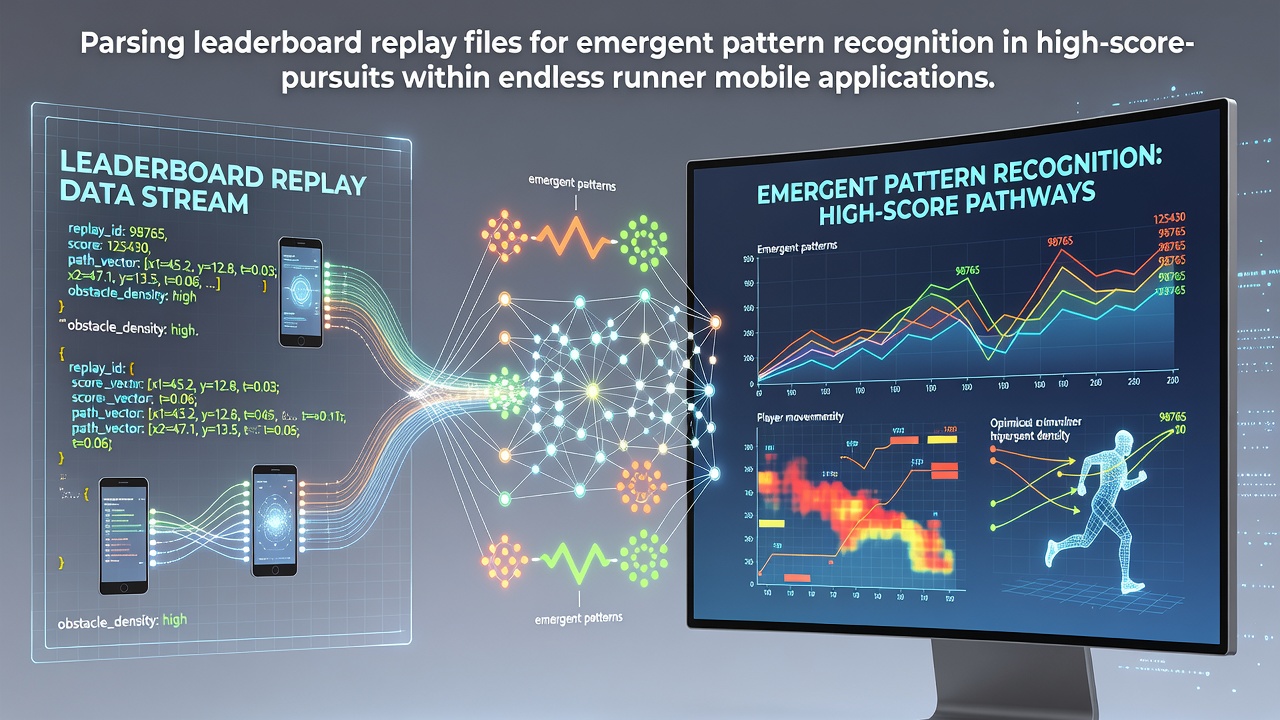
Endless runner mobile applications generate vast quantities of leaderboard data each day, and developers along with analysts parse replay files to extract structured information from player runs that reach top positions. These files capture sequences of inputs, positions, and events that define how high scores emerge across repeated sessions in titles such as Subway Surfers and Temple Run. Parsing begins with extraction of binary or JSON-formatted logs that record frame-by-frame coordinates, swipe timings, and collision avoidance events, after which scripts convert raw bytes into readable timelines that researchers examine for recurring sequences.
Replay File Formats and Extraction Methods
Mobile platforms store replay data in compact structures optimized for bandwidth, and parsing tools decode these structures by identifying header metadata that lists game version, device type, and session length before moving to the payload of movement vectors. Analysts apply libraries such as Python's struct module or custom C++ decoders to unpack timestamped events, and once unpacked the data reveals patterns like consistent lane switches at specific obstacle densities. In October 2026 several analytics firms released updated toolkits that handle encrypted replays from the latest engine updates, allowing continued access to files uploaded to global leaderboards.
Identifying Emergent Patterns Through Sequence Analysis
Pattern recognition algorithms process parsed timelines to detect clusters of actions that correlate with elevated scores, and techniques such as dynamic time warping compare runs from different players to isolate shared subsequences. One common finding involves synchronized power-up collection windows that appear in multiple top replays, where players activate boosts within a narrow temporal band after clearing a sequence of barriers. Data from aggregated leaderboards shows that these windows occur more frequently in runs exceeding the 95th percentile, and researchers apply clustering methods to group similar executions across thousands of files.
Movement and Timing Correlations
Parsed replays expose correlations between swipe velocity and survival duration, and statistical models quantify how slight adjustments in jump arcs reduce collision rates at higher speeds. Observers note that top performers maintain input intervals that align with procedural obstacle rhythms generated by the game's seed, and heatmaps derived from coordinate logs highlight preferred path corridors that minimize exposure to hazards. These corridors shift when new obstacle variants appear in seasonal updates, yet the underlying parsing pipeline remains adaptable through modular feature extractors.
Integration with Machine Learning Pipelines
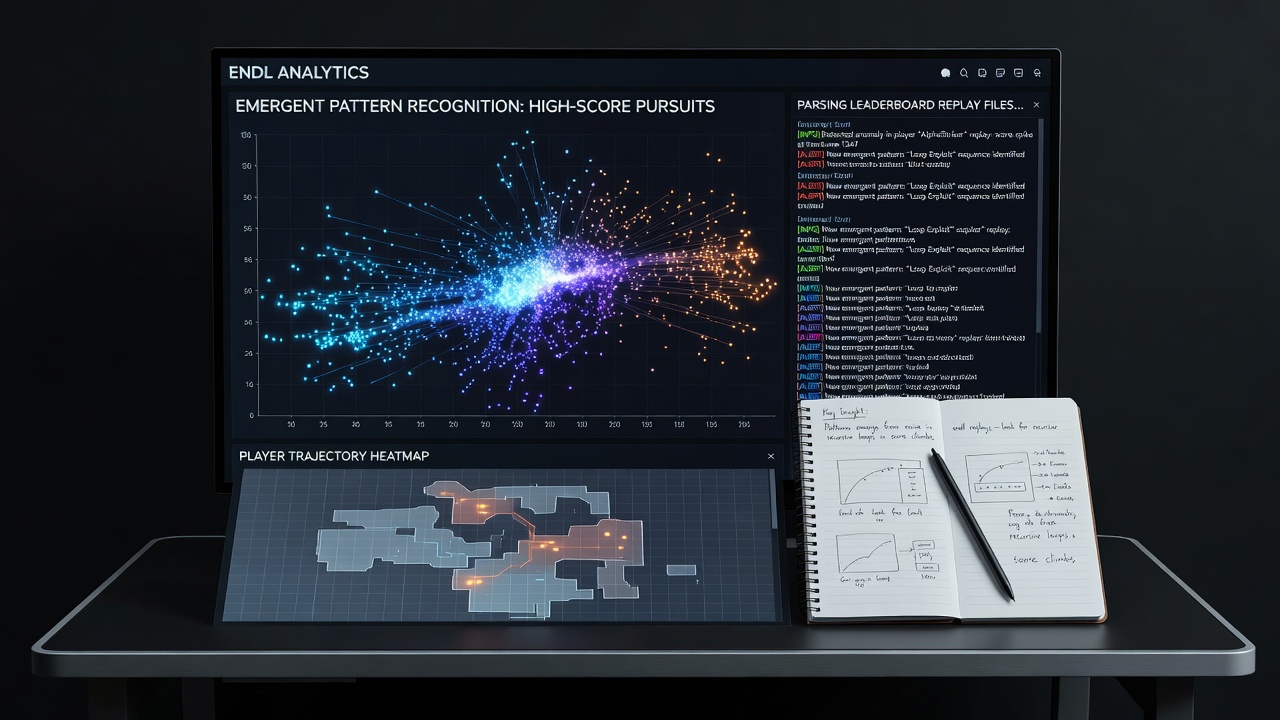
Machine learning frameworks ingest parsed replay datasets to train classifiers that predict score potential from early run segments, and recurrent neural networks process sequential input data to forecast likely continuation paths. Training sets drawn from public leaderboards contain millions of entries, and cross-validation against withheld high-score files confirms accuracy rates above baseline random guessing. Industry reports from the Entertainment Software Association indicate that studios increasingly allocate resources to such pipelines because they inform balance adjustments and tutorial refinements.
Feature engineering focuses on derived metrics such as average reaction latency and resource utilization efficiency, and these engineered features feed into gradient boosting models that rank influential variables. Analysts then map model outputs back to specific replay segments, producing annotated timelines that highlight decision points where players diverge from lower-scoring trajectories. Geographic diversity appears in the datasets because leaderboards aggregate submissions from multiple regions, and models trained on combined data generalize better than those limited to single-market samples.
Applications in Competitive Analysis and Development
Teams use parsed patterns to benchmark internal playtests against leaderboard distributions, and discrepancies prompt targeted adjustments to difficulty curves or item spawn rates. A second external reference comes from the International Game Developers Association surveys that track adoption of analytics tools among mobile studios. These surveys document rising use of replay parsing for identifying unintended exploits before they propagate through community leaderboards.
Visualization dashboards render aggregated paths as overlaid trajectories on level schematics, and interactive filters allow isolation of runs from specific date ranges or device classes. Such tools support iterative design cycles where observed patterns influence the next content patch, and version control systems archive parsed datasets alongside code commits for reproducibility.
Conclusion
Parsing leaderboard replay files supplies a factual basis for recognizing emergent patterns in endless runner high-score pursuits, and the resulting insights guide both competitive analysis and ongoing game updates. Continued refinement of extraction methods and analytical models ensures that developers maintain visibility into evolving player strategies across global mobile audiences.